×

Book a Demo

*First Name

*Last Name

*Work Email

*Company

Tell Us How We Can Be Successful Together

Submit →

Thank you. The form was submitted successfully. You can now close this modal.

Ransomware Defense

Enforce the Known
Good, automatically.

Mimic Ransomware Defense enforces known-good state at the kernel, blocking ransomware, stolen credential attacks, and unauthorized change before they execute. No signatures. No behavioral guessing. Enforcement evaluates each change before file encryption can begin, so a contained event does not become operational downtime.

Secure critical
infrastructure at the core.

Define Known Good

Define Known Good

Build a precise model of every authorized file, process, registry key, and service.

Eliminate Unauthorized Changes

Eliminate unauthorized changes

Defend based on what’s allowed—no more blocklists, signatures, or chasing.

Block Stolen Credentials

Block stolen credentials

Defuse adversaries with approved tools and identities via the authorization model.
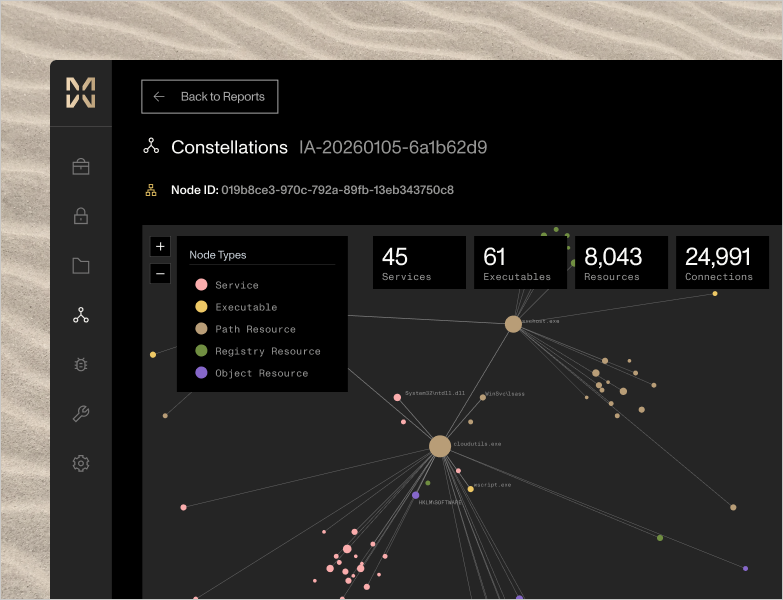
Ransomware Defense - Protect UI

Neutralize threats across
your organization.

Intercept damage before it lands

Obstruct attacks at the kernel in under 50 milliseconds, before encryption starts.

Enforce chart

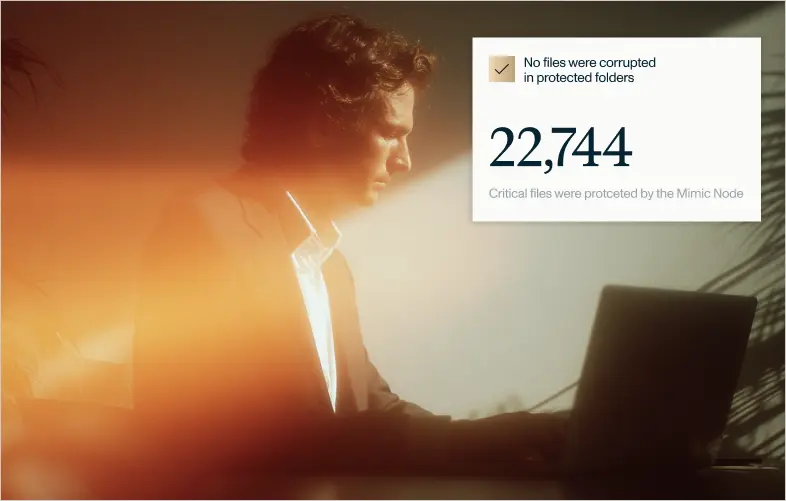
Establish proof of system integrity.

Document UI

Understand what happened

Review a complete forensic record of what changed, when it changed, and what touched it.

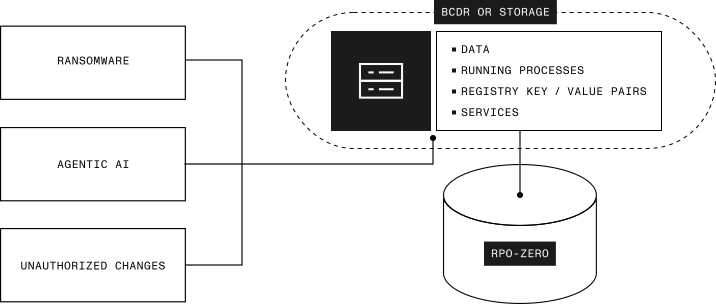
Guarantee RPO-Zero Backup trigger

Trigger backup infrastructure to snapshot critical systems the instant an attack is detected.

Deliver board-ready answers

Present a full forensic audit on every attempted modification—before
anyone asks.

Active Directory is ransomware's favorite target. Here's how Mimic defended REI's.
Read the case study
Right arrow

Our difference in defense.

Without Mimic

Without Mimic
Ransomware Defense

  • Human-speed for AI-speed threats
  • Surface level detection without prevention
  • Incomplete view into data loss with partial records
With Mimic

With Mimic
Ransomware Defense

  • AI-speed defense built for AI-adversaries
  • Known-good protection at the deepest level
  • Zero data loss with a complete forensic record

Built for resilience,
at every layer.

Safe kernel sandbox

Safe kernel sandbox

Trust kernel-level enforcement that’s built on Wasm, Microsoft-approved, and can’t take you down.

Application forensics

Application forensics

Review a time-stamped record of every attack, including what changed and what touched it.

RPO zero

RPO zero

Record a recovery snapshot of critical systems the instant an attack is detected.

FAQ

Frequently asked questions

What is the best ransomware defense for enterprise systems?

The most reliable ransomware defense stops encryption before it executes rather than detecting it after files change. Mimic enforces known-good state at the kernel, evaluating every attempted change against a verified baseline of authorized files, processes, registry keys, and services. Ransomware needs unauthorized change to achieve impact, so blocking that change at the kernel removes the outcome without requiring a signature or behavioral match.

How does kernel-level ransomware defense work?

Kernel-level defense evaluates change at Ring 0, below where user-space processes including ransomware run. Mimic builds a model of every authorized file, process, registry key, and service on a protected system during onboarding. That model becomes the enforcement policy. Each later change attempt is checked against it before execution, so file encryption, registry persistence, and lateral movement are stopped at the point where they would otherwise take effect.

What is the difference between ransomware prevention and ransomware detection?

Detection identifies ransomware after it starts executing by matching activity against known signatures or behavioral patterns. Prevention stops it before it executes and requires no match. Mimic uses a prevention model. It does not need to recognize the variant, only to determine whether the attempted change is inside the authorized baseline. An unauthorized encryption attempt fails that check and does not run.

Can ransomware bypass known-good enforcement?

Ransomware cannot achieve impact without changing something: encrypting files, modifying registry keys, establishing persistence, or moving laterally. Each of those is evaluated against the known-good baseline at the kernel before it executes. A variant that evades signature matching, arrives as a signed binary, or runs through an approved administrative tool still faces the same question about whether the change was authorized, and an unauthorized one does not proceed.

How do you stop ransomware that uses stolen credentials?

Ransomware operators increasingly use valid administrative credentials and approved tools, which makes the activity look legitimate to identity and endpoint controls. Mimic evaluates the change rather than the credential. An attacker holding valid credentials still has to write new binaries, modify registry keys, or alter services, and those changes sit outside the known-good baseline, so they are blocked at the kernel regardless of who requested them.

Why do signatures fail to stop modern ransomware?

Signature matching requires prior knowledge of the attack. Operators routinely alter variants, sign their binaries, or execute through legitimate administrative tooling specifically to avoid a match. Mimic consults no signature database in the enforcement decision. The question it answers is whether a change falls inside the authorized baseline, which resolves the same way whether the ransomware is a known family or has never been seen.

How fast does Mimic block a ransomware attempt?

Mimic obstructs attacks at the kernel in under 50 milliseconds, before encryption starts. That timing matters because detect-and-respond models allow some encryption to complete between the first malicious write and the response. Enforcement evaluates the change before it executes rather than reacting to its effects, so the decision happens at the point of change rather than after damage has begun.

What is RPO-Zero in ransomware recovery?

A Recovery Point Objective of zero means recovery does not fall back to the last scheduled backup. Mimic triggers backup infrastructure to snapshot protected critical systems the instant an attack is identified, rather than on a fixed schedule. Because enforcement blocked the unauthorized change before it altered the system, the snapshot captures a clean state and recovery does not begin from partially encrypted data.

What is a known-good baseline?

A known-good baseline is a verified record of a system's authorized operational state, covering every file, process, registry key, and service it uses in normal approved operation. Mimic builds this by profiling each protected system during onboarding, and the baseline then becomes the enforcement policy. Every later change attempt is measured against it at the kernel, and anything outside it does not execute.

Is kernel-level security safe to run on production systems?

Kernel-level tooling has a history of causing outages when a faulty update destabilizes the host. Mimic's enforcement runs inside a sandbox built on WebAssembly, an approach designed so that the enforcement layer does not destabilize the operating system it protects. That allows enforcement to sit at the kernel, which is the most effective position for stopping ransomware, without exposing production systems to that failure mode.

What forensic record does Mimic produce after a ransomware attempt?

Mimic captures a time-stamped record of every attempted change: what changed, when, which process touched it, and whether the attempt was permitted or blocked. The record is written at the kernel, below the layer where ransomware typically tampers with logs. Because it accumulates as enforcement acts, investigation and audit start from retrieval rather than reconstruction after the fact.

How do you defend against ransomware that operates at machine speed?

Automated ransomware compresses the attack timeline below what human-monitored response can meet. Enforcement removes the human step from the decision. Mimic evaluates every change attempt at the kernel automatically and blocks unauthorized ones before they execute, so the defense operates on the same timescale as the attack rather than reacting once the attack has already changed the system.

How do you protect critical infrastructure from ransomware?

Critical infrastructure needs ransomware defense that does not interrupt operations and does not depend on signature updates reaching the system. Mimic builds the known-good model from each system's own authorized state, so enforcement is specific to how that system legitimately runs. Authorized operations proceed untouched, and only changes falling outside the baseline are blocked, which keeps enforcement viable on systems that cannot tolerate downtime.

How is Mimic different from EDR for ransomware?

EDR identifies ransomware by observing behavior and matching known attack patterns, which means some encryption usually completes before the response begins. Mimic enforces the authorized state at the kernel instead, so no match is needed. EDR requires knowing what the attack looks like. Mimic requires knowing what the approved state looks like. Mimic runs alongside EDR rather than replacing it.

What does zero data loss from ransomware require?

Zero data loss depends on stopping encryption before it alters file data, not on restoring quickly afterward. Mimic blocks unauthorized writes at the kernel before encryption begins, and triggers an event-driven snapshot of protected critical systems when an attack is identified. Because no encryption completed, that snapshot reflects an uncompromised state and recovery does not involve scrubbing partially encrypted files.